Designing a card-driven game for manager training.
I was fortunate enough to blend my love of game design and instructional design into a recent learning experience design project for a large QSR corporation. The directive was clear: we needed a spicy new way to deliver corporate manager training for the upcoming quarterly meeting.
The feedback from previous sessions was brutally honest:
“People are bored.”
“No one wants to participate.”
“We need to do something different this time.”
When this challenge arose at work, I happened to be enrolled in a tabletop game design course at Central Michigan University’s Center for Learning Through Games and Simulations. I was learning from the great Damon Stone, creator of popular tabletop games like Android: Netrunner and DC Forever. The use of serious games and gamification is growing rapidly in the field of instructional design. In fact, some of the best learning experiences I’ve ever created bake in elements and mechanics from video games. How do you motivate a learner? How do you make them want to progress through a journey, adjust the difficulty organically, and scaffold their learning? Most importantly, how do you make them want to learn? These are the questions traditional game designers answer every day, and it's a mindset I constantly incorporate into my instructional design business. But I digress.
Back to the task at hand. I pitched my solution: “...how about a card game?”
The response: “That’s the worst idea I’ve ever heard, Tommy... but it’s all we got. Let's go with it.”
Because this instructor-led training (ILT) was delivered in person, I needed a solution that was small, portable, and easy to hand out. My immediate thought went to card games. Disclaimer: I love card games. Pokémon, Magic: The Gathering, these are the games I grew up with. Card games are unique because you can pack so much information, strategy, and narrative onto a few small pieces of paper. Together, they can tell a story, represent a conflict, or simulate a real-world scenario.
Card games are also fantastic icebreaker tools because they are unassuming, lightweight, and accessible to anyone. Drawing inspiration from highly social titles like Cards Against Humanity and Spot It, I wanted easy mechanics that anyone could pick up and play.
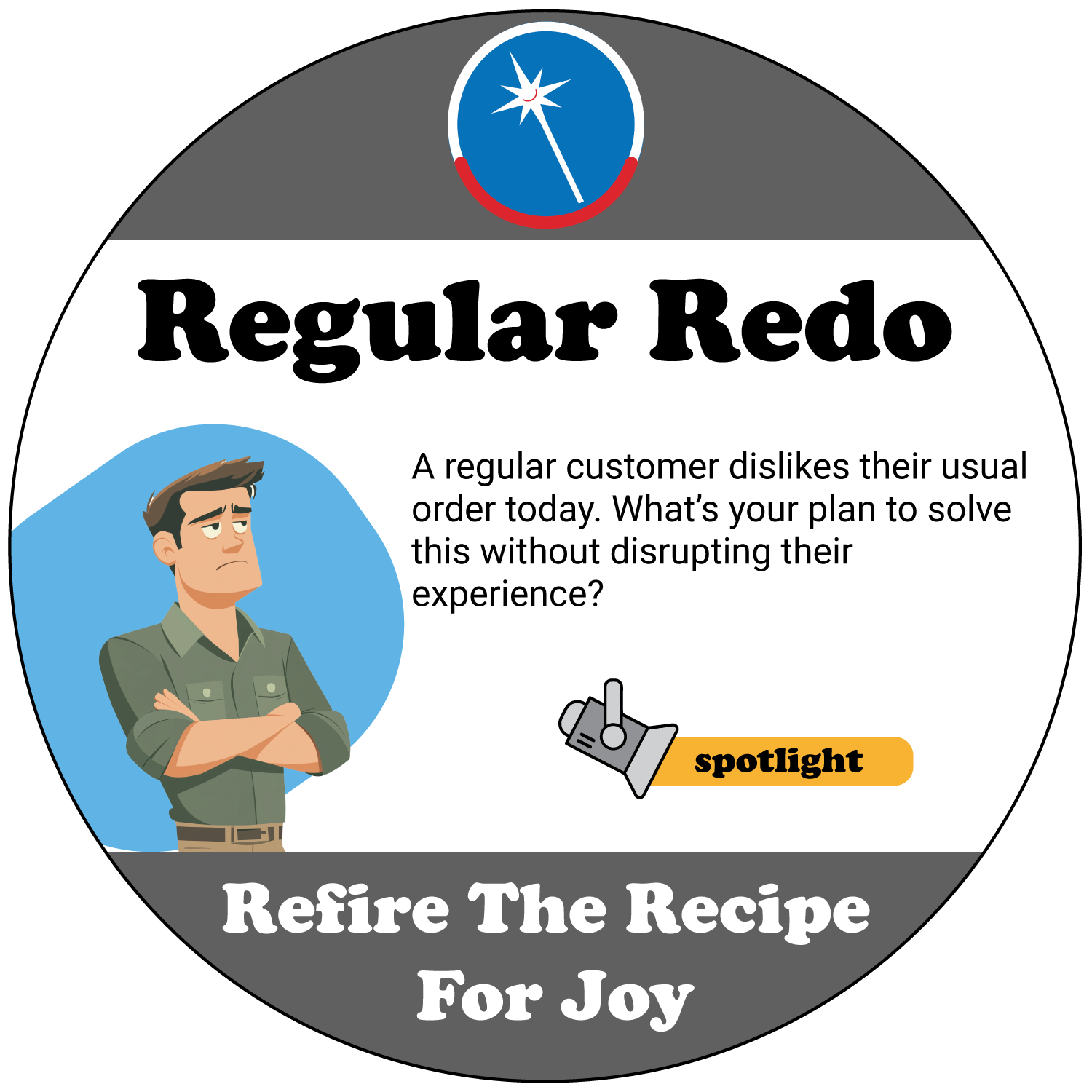
example card from the game
The real purpose of the game, titled iHospitality Heroes, was to drive meaningful conversation and learner engagement between the managers. We collected around 500 different scenarios from subject matter experts (SMEs) across the organization to build the deck. Each card featured a real-world scenario that managers would have to tackle individually, in pairs, or as a wider group. To keep them on their toes, we introduced challenge mechanics like a 30-second time limit or a "Flip-it!" icon that forced them to think like the customer rather than the manager. To win, teams had to collect cards representing core company principles by proving to the room that they had the best solution. Through a Socratic seminar-style approach, this material activated their prior knowledge, broke down their walls, and made them genuinely excited to be at the training.
I wish I could have taken pictures at the events. The first time they saw the cards, a whole bouquet of emotions was on display: excitement, confusion, even mild disgust. But after a couple of minutes of silence, the room erupted. We heard passionate discussions, laughter, and friendly arguments. The gamified learning was working. People were talking, people were engaged, and it was amazing to behold.
If you’d like to learn more about my learning experience design process for this approach, you can view the game design document here.