Point of Sale (POS) Training Simulation: a Boba Shop Case Study
In two months, guest satisfaction rose 40% and drink remakes dropped by nearly half. I created a custom POS training simulation for a family-owned boba shop in the San Gabriel Valley that drove real behavioral change. New hires played the game for just 10 minutes before and after each shift, directly improving the business's bottom line.
The business problem
The perfect opportunity came from an acquaintance who owns a family-owned boba shop in the San Gabriel Valley:
“All of my new hires keep messing up on standard orders. We have POS training for new employees built into onboarding, but it’s not working. I’m having to remake drinks constantly… Don’t you make… training… or something?”
Lucky for them, I love boba. And yes, I do make training… or something.
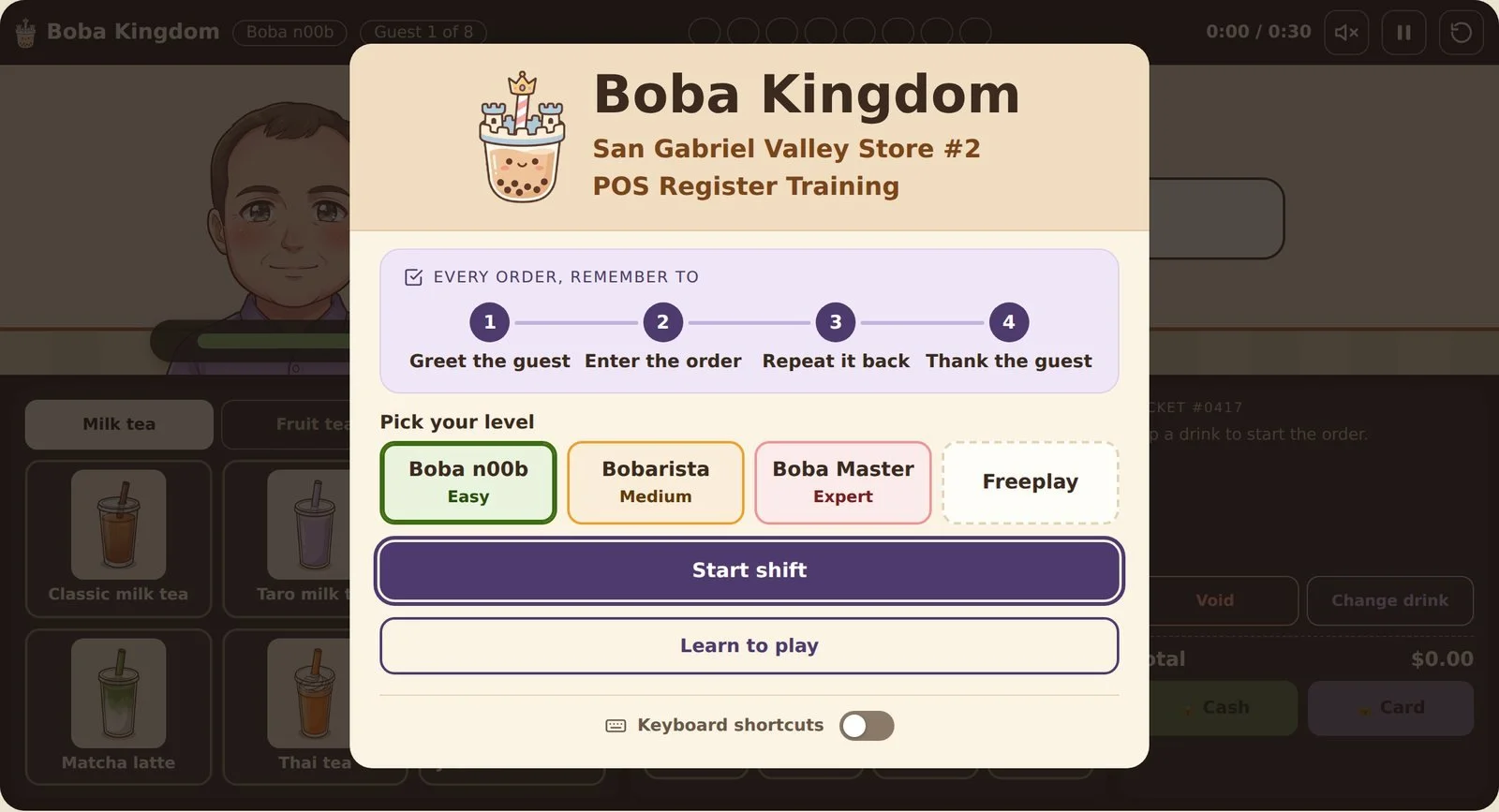
Title screen from Boba Kingdom
The Root Cause
After observing the store for a few sessions and interviewing the staff, the root cause was obvious. They had excellent live training, but it only lasted two days. Because new staff learned the register on the job during live rushes, they felt uncomfortable, lacked confidence, and were visibly scared to handle real customer interactions. The gap was created from a lack of practice, not knowledge.
The Solution
Supplemental training needed to let staff practice desired behaviors in a risk-free environment. I built Boba Kingdom, a 10-minute custom POS training game that uses gamified principles to drive realistic repetitions.
We set a clear, measurable performance objective:
“Cashiers must be able to ring up a fully custom order with no mistakes in under 30 seconds.”
In the game, every order follow the store SOP’s four steps:
Greet within five seconds
Enter the order
Repeat it back
Thank the guest
After speaking with the owner and veteran staff, I created the five most common guest personas they’ve encountered on the job to make the simulation feel more authentic and to inform guest scripting decisions.
In a hurry: Needs everything done ASAP.
Changes their mind: Changes the drink order while ordering.
Unclear: The cashier doesn’t understand what they need.
Indecisive: Doesn’t know what they want.
Picky: Knows exactly what they want and how they want it.
The game uses a 3-star scoring system where perfection (including speed and accuracy) earns three stars. Players navigate three main levels that scaffold in difficulty (Boba n00b, Bobarista, and Boba Master) as well as an endless Freeplay mode.
The ROI
To know if our training was working, we aligned our goal with concrete business metrics. New hires played the game for just 10 minutes before and after each shift. After two months, we pulled data from the store's guest surveys, POS records, and Vercel Analytics. The numbers showed massive improvement, directly improving the business's bottom line:
+40% guest satisfaction scores (from store surveys).
−30% average time spent with each guest (recorded by the POS).
Nearly 50% fewer drinks remade (tracked by the POS).
While other factors can occasionally boost survey scores, the sharp drop in drink remakes and faster transaction speeds provide a direct link to the training.
Design Decisions
The Approach
I’d been waiting for a worthwhile project to use Claude Code for. Traditional eLearning tools are changing by the hour, and with AI taking over my feeds, I wanted a tangible way to put these new tools into action.
For the record, I believe AI is a fantastic tool, but it can never replace a real designer.
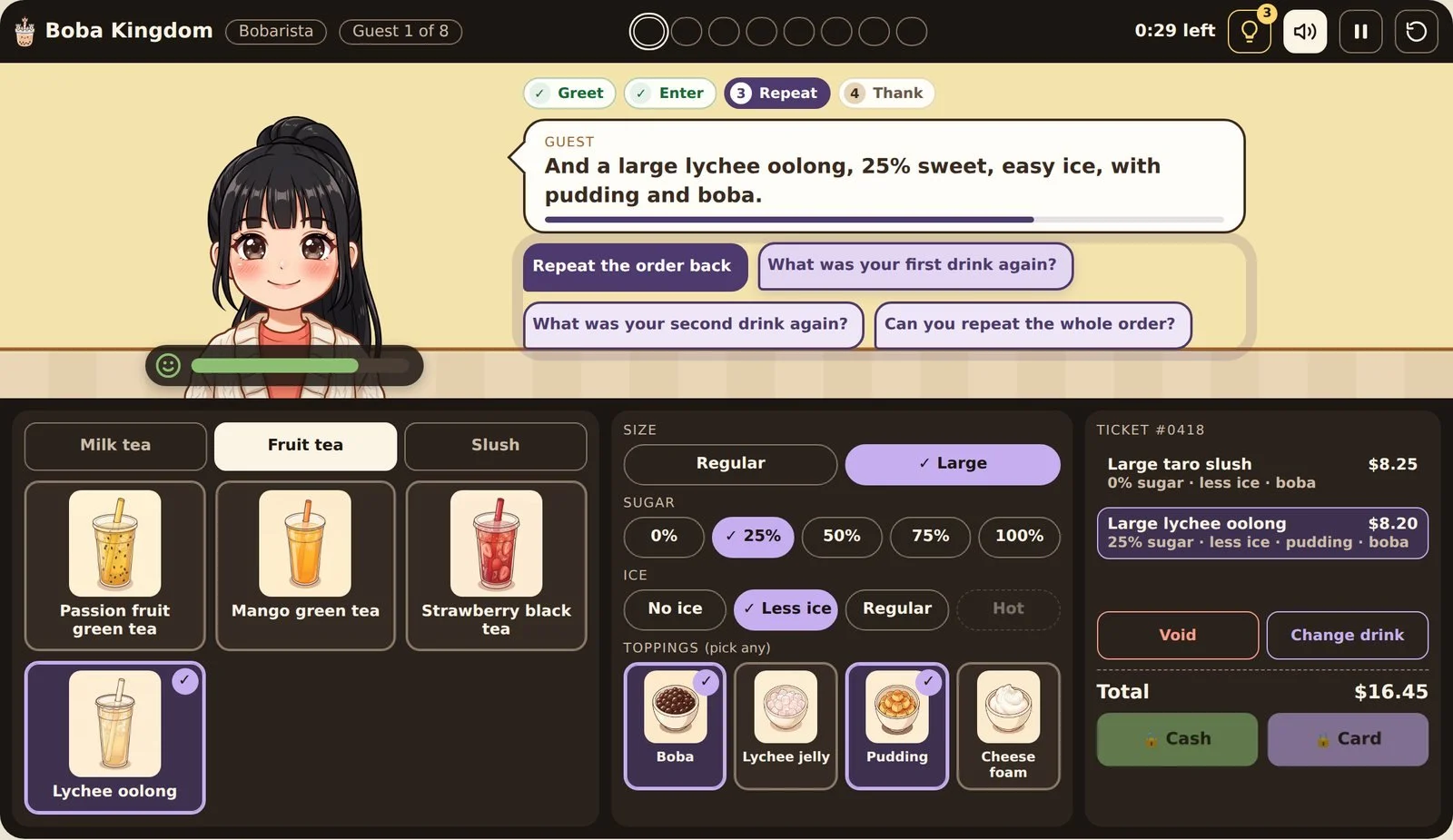
Screenshot of gameplay from Boba Kingdom
Realistic Layout
The screen is set up from the exact POV of the Cashier. The register interface provides a high-fidelity simulation of the live POS environment, promoting positive transfer of learning and maximizing skill retention through situated practice.
Mechanics
Active Listening: Guests order one drink at a time using everyday words. Because their speech text fades away, players have to practice entering orders while they listen.

Practice under pressure
The simulation reflects the real demands of the role. A visible patience meter drains in 30 seconds, and good moves fill it back up, just like managing a real customer's patience. If the guest isn’t served in a reasonable amount of time, their patience wanes and visibly drops.
Real guest language
To make this scenario-based eLearning effective, we used language from direct observations and cashier interviews.
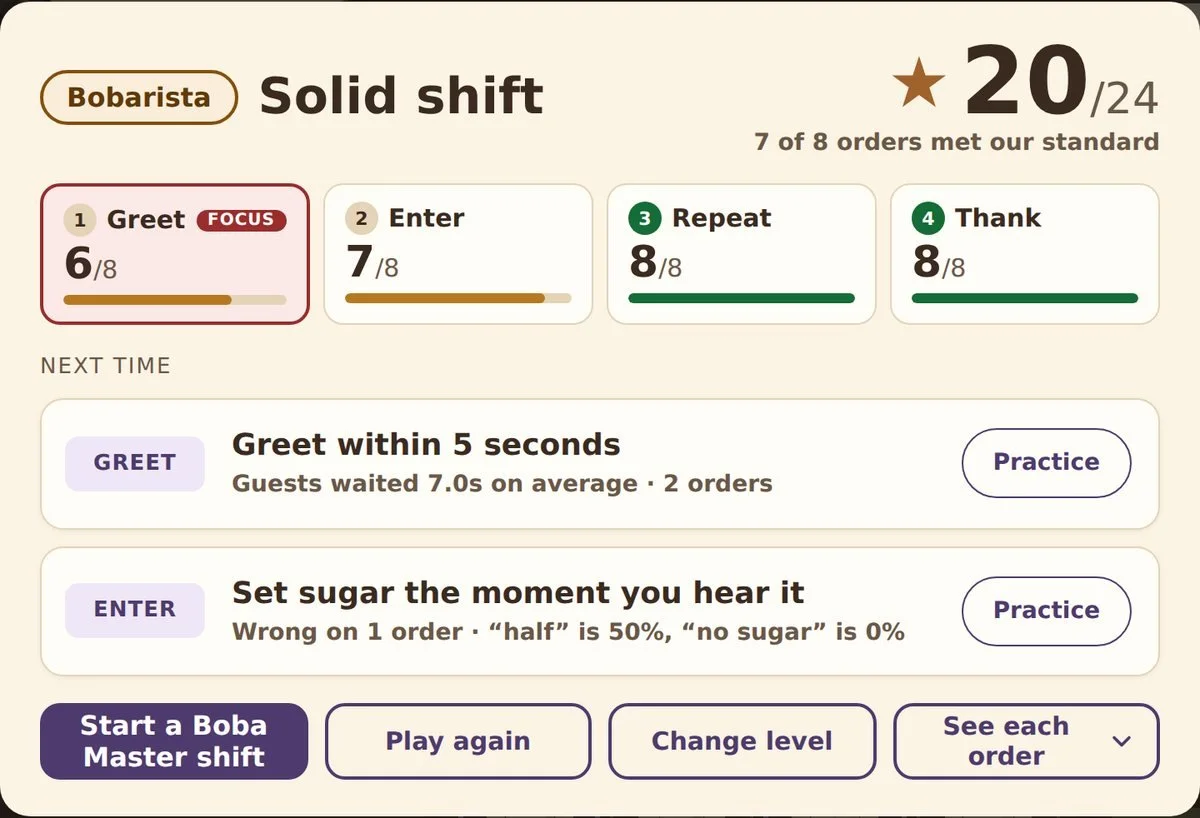
Feedback + Targeted Practice
Feedback is immediate after each playthrough. The review screen shows a score for each of the four steps and highlights only the two most useful tips. A [Practice] button next to each tip drops the player right back into that specific step to try it three times in a row, offering concrete areas for improvement.
Short sessions & Accessibility
Each playthrough was optimized for a maximum of 10 minutes. This allowed learners to fit in training before and after work, creating spaced practice without pulling anyone off the floor or hurting the business.
Accessibility was prioritized throughout the design process. The game meets WCAG 2.1 AA standards, features full keyboard support, and works perfectly on the shop's tablet.
Iteration through play
Testing early and often is a massive part of my iteration process. I tested the game with the business owner, key stakeholders, and staff. Based on their early feedback, I updated the game to include six kinds of order changes, more everyday wording, hot milk teas, and a Freeplay ladder that automatically increases difficulty as you win.
Tools and tech
I built this HTML5 training simulation using CSS and JavaScript. It requires no plugins and runs smoothly in any web browser. The build process utilized:
Claude Code and Figma.
AI-generated character art (Nano Banana Pro), refined into 36 animation frames.
Automated browser testing across phone, tablet, and desktop.
Vercel for backend analytics and tracking.
Reflection: V/O and Character Audio
While the project was a success, future iterations would benefit from voice integration and character audio. Allowing learners to actually speak rather than click provides much better practical feedback, despite the trade-off of increased cost and production time.
What this means for your business
Effective employee training doesn't have to disrupt your floor. Whether you run a busy café, a retail shop, or a hotel, customer service training shouldn't rely on stressful, live practice in front of paying customers.
Have a training gap like this?
If you’re looking for an Instructional Designer in Los Angeles, I work with teams across the region to build custom solutions.